Analyzing
Facial Expressions and Emotions in Three Dimensional Space with Multimodal
Sensing
Introduction
Traditionally, human
facial expressions have been studied using either 2D static images or 2D video
sequences. The 2D-based analysis is difficult to handle large pose variations
and subtle facial behavior. This exploratory research targets the facial
expression analysis and recognition in a 3D space as well as emotion analysis
from multimodal data. The analysis of 3D facial expressions will facilitate the
examination of the fine structural changes inherent in the spontaneous
expressions. The project aims to achieve a high rate of accuracy in identifying
a wide range of facial expressions and emotions, with the ultimate goal of
increasing the general understanding of facial behavior and 3D structure of
facial expressions and emotions on a detailed level. Following databases are released for
public: (1) BU-3DFE (2006), (2) BU-4DFE
(2008), (3) BP4D-Spontaneous (2014), (4) BP4D+ (2016), (5) EB+ (2019), (6)
BU-EEG (2020), (7) BP4D++ (2023), and (8) ReactioNet
(2023)
Project Progress
I. BU-3DFE (
3D facial
models have been extensively used for 3D face recognition and 3D face
animation, the usefulness of such data for 3D facial expression
recognition is unknown. To foster the research in this field, we created a
3D facial expression database (called BU-3DFE database),
which includes 100 subjects with 2500 facial expression models. The BU-3DFE
database is available to the research community (e.g., areas of interest come
from as diverse as affective computing, computer vision, human computer
interaction, security, biomedicine, law-enforcement, and psychology.)
The database presently contains 100 subjects (56% female, 44% male), ranging
age from 18 years to 70 years old, with a variety of ethnic/racial ancestries,
including White, Black, East-Asian, Middle-east Asian, Indian, and Hispanic
Latino. Participants in face scans include undergraduates, graduates and
faculty from our institute’s departments of Psychology, Arts, and Engineering
(Computer Science, Electrical Engineering, System Science, and Mechanical
Engineering). The majority of participants were undergraduates from the
Psychology Department (collaborator: Dr. Peter Gerhardstein).
Each subject performed seven expressions in front of the 3D face scanner. With
the exception of the neutral expression, each of the six prototypic
expressions (happiness, disgust, fear, angry, surprise and sadness)
includes four levels of intensity. Therefore, there are 25 instant 3D
expression models for each subject, resulting in a total of 2,500 3D facial
expression models in the database. Associated with each expression shape model,
is a corresponding facial texture image captured at two views (about +45° and -45°). As a result, the database consists of 2,500 two-view’s
texture images and 2,500 geometric shape models.
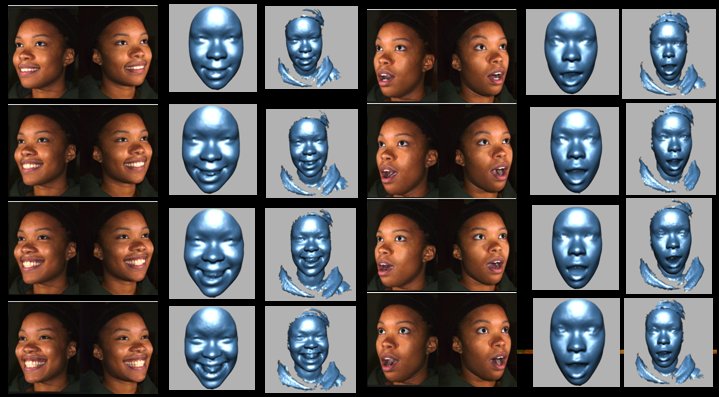
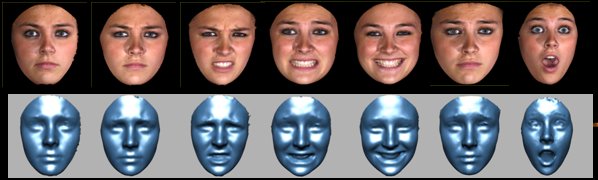
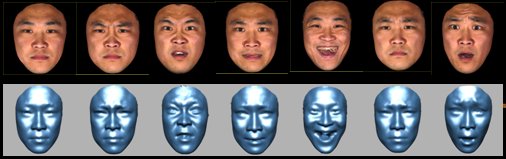
Top: Four levels of facial
expressions from low to high. Expression models show the cropped face region
and the entire facial head; Middle
and Bottom: Seven expressions female and male (neutral, angry, disgust,
fear, happiness, sad, and surprise), with face images and facial models
Facial Expression Recognition Based On BU-3DFE
Database
We
investigated the usefulness of 3D facial geometric shapes to represent and
recognize facial expressions using 3D facial expression range data. We
developed a novel approach to extract primitive 3D facial expression features,
and then apply the feature distribution to classify the prototypic facial
expressions. Facial surfaces are classified by the primitive surface features
based on the surface curvatures. The distribution of these features are used as
the descriptors of the facial surface, which characterize the facial
expression. We conducted the person-independent study to recognize the facial
expression contained in our BU-3DFE Database, the result shows about 83%
correct recognition rate in classifying six universal expressions using LDA
approach.
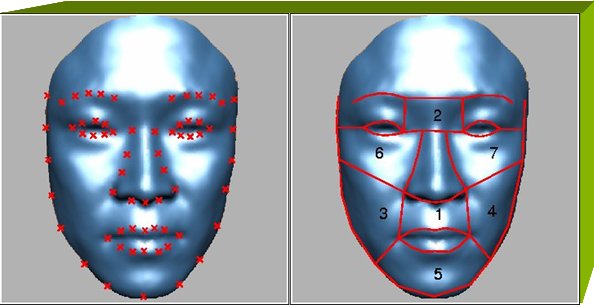
Expressive regions
defined for facial surface primitive feature
Requesting Data (BU-3DFE)
With the agreement of the technology
transfer office of the SUNY at
Note: (1)
Students are not eligible to be a recipient. If you are a student, please
have your supervisor to make a request. (2) Once the agreement form is signed,
we will give access to download the data.
If this data is used, in whole or in
part, for any publishable work, the following paper must be referenced:
”A 3D Facial Expression Database For Facial Behavior Research” by
Lijun Yin; Xiaozhou Wei; Yi Sun; Jun Wang; Matthew J.
Rosato, 7th International Conference on Automatic
Face and Gesture Recognition, 10-12 April 2006 P:211 - 216
II. BU-4DFE (3D + time): A 3D
Dynamic Facial Expression Database (Dynamic Data)
To analyze the facial behavior from a static 3D
space to a dynamic 3D space, we extended the BU-3DFE to the BU-4DFE.
Here we
present a newly created high-resolution 3D dynamic facial expression database,
which is made available to the scientific research community. The 3D facial
expressions are captured at a video rate (25 frames per second). For each
subject, there are six model sequences showing six prototypic facial
expressions (anger, disgust, happiness, fear, sadness, and surprise),
respectively. Each expression sequence contains about 100 frames. The
database contains 606 3D facial expression sequences captured from 101
subjects, with a total of approximately 60,600 frame models. Each 3D model of a
3D video sequence has the resolution of approximately 35,000 vertices. The
texture video has a resolution of about 1040×1329 pixels per frame. The
resulting database consists of 58 female and 43 male subjects, with a variety
of ethnic/racial ancestries, including Asian, Black, Hispanic/Latino, and
White.
 Individual model views

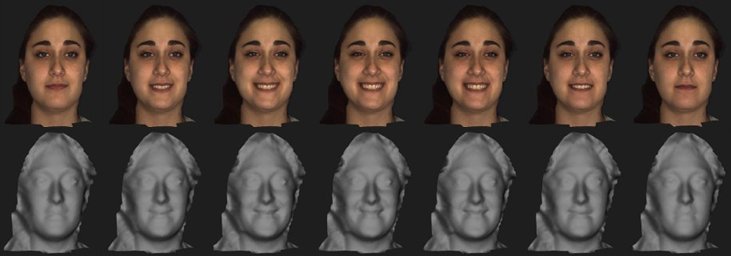
Sample expression model sequences (male and female)
Requesting Data (BU-4DFE)
With the agreement of the technology transfer office of the SUNY at
Note:
(1) Students are not eligible to be a recipient. If you are a student,
please have your supervisor to make a request.
(2) Once a license agreement is signed, we will give access to download the
data.
(3) If this data is used, in whole or in part, for any publishable work,
the following paper must be referenced:
”A High-Resolution 3D Dynamic Facial Expression Database”
by Lijun Yin; Xiaochen Chen; Yi Sun; Tony Worm;
Michael Reale, The 8th International Conference on
Automatic Face and Gesture Recognition, 17-19 September 2008 (Tracking Number:
66)
PI:
Dr. Lijun Yin.
Research
Team: Xiaozhou Wei, Yi Sun, Jun Wang, Matthew Rosato, Myung Jin Ko, Wanqi Tang, Peter Longo, Xiaochen
Chen, Terry Hung, Michael Reale, Tony Worm, and Xing
Zhang.
Collaborator:
Dr. Peter Gerhardstein of Psychology, SUNY Binghamton and his team (Ms. Gina
Shroff).
Related Publications:
·
Lijun Yin, Xiaozhou Wei, Yi Sun, Jun
Wang, and Matthew Rosato, “A 3D Facial Expression
Database For Facial Behavior Research”. The 7th International Conference on
Automatic Face and Gesture Recognition (2006). IEEE Computer Society
TC PAMI. Southampton, UK, April 10-12 2006. p211-216 [PDF]
·
Lijun Yin and Xiaozhou Wei,
“Multi-Scale Primal Feature Based Facial Expression Modeling and
Identification”. The 7th International Conference on Automatic Face and
Gesture Recognition (2006), IEEE Computer Society TC PAMI.
Southampton, UK, April 10-12 2006. p603-608 [PDF]
·
Jun Wang, Lijun Yin, Xiaozhou Wei, and Yi Sun, “3D Facial Expression Recognition
Based on Primitive Surface Feature Distribution”, IEEE International
Conference on Computer Vision and Pattern Recognition (CVPR 2006),
·
L. Yin, X. Wei, P. Longo,
and A. Bhuvanesh, “Analyzing Facial Expressions Using
Intensity-Variant 3D Data for Human Computer Interaction”, 18th
IAPR International Conference on Pattern Recognition (ICPR 2006), Hong
Kong. p1248 – 1251. (Best Paper Award) [PDF]
·
Y. Sun and L. Yin, “Evaluation of
3D Facial Feature Selection for Individual Facial Model Identification”, 18th
IAPR International Conference on Pattern Recognition (ICPR 2006), Hong
Kong. p562- 565. [PDF]
·
J. Wang and L. Yin, “Static
Topographic Modeling for Facial Expression Recognition and Analysis”, Computer
Vision and Image Understanding, Elsevier Science. Nov. 2007. p19-34. [PDF]
·
L. Yin, X. Chen, Y. Sun, T. Worm,
and M. Reale, “A High-Resolution 3D Dynamic Facial
Expression Database”, The 8th International Conference on Automatic
Face and Gesture Recognition (2008), 17-19 September 2008 (Tracking Number: 66).
IEEE Computer Society TC PAMI. Amsterdam, The Netherlands. [PDF]
·
Y. Sun and L. Yin, “Facial
Expression Recognition Based on 3D Dynamic Range Model Sequences". The
10th European Conference on Computer Vision (ECCV08), October 12-18, 2008, Marseille,
France. [PDF]
III. BP4D-Spontaneous:
Binghamton-Pittsburgh 3D Dynamic Spontaneous Facial Expression Database
Because posed and un-posed (aka
“spontaneous”) 3D facial expressions differ along several dimensions including
complexity and timing, well-annotated 3D video of un-posed facial behavior is
needed. We present a newly developed 3D video database of spontaneous facial
expressions in a diverse group of young adults. Well-validated emotion
inductions were used to elicit expressions of emotion and paralinguistic
communication. Frame-level ground-truth for facial actions was obtained using
the Facial Action Coding System. Facial features were tracked in both 2D and 3D
domains using both person-specific and generic approaches. The work promotes
the exploration of 3D spatiotemporal features in subtle facial expression,
better understanding of the relation between pose and motion dynamics in facial
action units, and deeper understanding of naturally occurring facial action.
The
database includes forty-one participants (23 women, 18 men). They were 18 – 29
years of age; 11 were Asian, 6 were African-American, 4 were Hispanic, and 20
were Euro-American. An emotion
elicitation protocol was designed to elicit emotions of participants
effectively. Eight tasks were covered with an interview process and a series of
activities to elicit eight emotions.
The
database is structured by participants. Each participant is associated with 8
tasks. For each task, there are both 3D and 2D videos. As well, the Metadata
include manually annotated action units (FACS AU), automatically tracked head
pose, and 2D/3D facial landmarks. The
database is in the size of about 2.6TB (without compression).
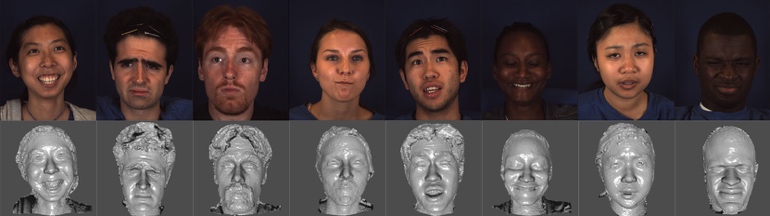
Sample
Expressions for Eight Tasks
Requesting Data (BP4D-Spontaneous)
With the agreement of the licensing office of the Binghamton University and
Pittsburgh University, the database is available for use by external parties.
Due to agreements signed by the volunteer models, a written agreement must
first be signed by the recipient and the research administration office
director of your institution before the data can be provided. Furthermore, the
data will be provided to parties who are pursuing research for non-profit use.
To make a request for the data, please contact Dr.
Lijun Yin at lijun@cs.binghamton.edu. To make a
request for the data, please contact Dr.
Lijun Yin at lijun@cs.binghamton.edu. For any
profit/commercial use of such data, please also contact Dr. Lijun Yin and Ms.
Amy Breski <abreski@binghamton.edu> and
<innovation@binghamton.edu> of the Office of Technology Licensing
and Innovation Partnerships.
Note:
(1) Students are not eligible to be a recipient. If you are a student,
please have your supervisor to make a request.
(2) Once a license agreement is signed, we will give access to download the
data.
(3) If this data is used, in whole or in part, for any publishable work,
the following paper(s) must be referenced:
· Xing Zhang, Lijun Yin, Jeff Cohn, Shaun
Canavan, Michael Reale, Andy Horowitz, Peng Liu, and Jeff
Girard, “BP4D-Spontaneous: A high resolution spontaneous 3D dynamic facial
expression database”, Image and Vision Computing, 32 (2014), pp. 692-706 (special issue of the Best of FG13)
· Xing Zhang, Lijun Yin, Jeff Cohn, Shaun
Canavan, Michael Reale, Andy Horowitz, and Peng Liu,
“A high resolution spontaneous 3D dynamic facial expression database”, The 10th
IEEE International Conference on Automatic Face and Gesture Recognition
(FG13), April, 2013.
Research Team:
Binghamton
University: Lijun Yin, Xing Zhang, Andy Horowitz, Michael Reale,
Peter Gerhardstein, Shaun Canavan, and Peng Liu
University
of Pittsburgh: Jeff Cohn, Jeff Girard, and Nicki Siverling
Related Publications:
· X.
Zhang, L. Yin, J. Cohn, S. Canavan, M. Reale, A.
Horowitz, and P. Liu, “A high resolution spontaneous 3D dynamic facial
expression database”, The 10th
IEEE International Conference on Automatic Face and Gesture Recognition (FG13), April, 2013.
· Xing Zhang, Lijun Yin, Jeff Cohn, Shaun
Canavan, Michael Reale, Andy Horowitz, Peng Liu, and
Jeff Girard, “BP4D-Spontaneous: A high resolution spontaneous 3D dynamic facial
expression database”, Image and Vision Computing, 32 (2014), pp. 692-706 (special issue of the Best of FG13)
· M. Reale, X. Zhang, L. Yin, "Nebula Feature: A Space-Time
Feature for Posed and Spontaneous 4D Facial Behavior Analysis", The10th IEEE International Conference on
Automatic Face and Gesture Recognition (FG13), April, 2013.
· S. Canavan, X. Zhang,
and L. Yin, “Fitting and tracking 3D/4D facial data using a temporal deformable
shape model”, IEEE International
Conference on Multimedia and Expo. (ICME13), 2013.
· P. Liu, M. Reale, and L. Yin, “Saliency-guided 3D head pose estimation
on 3D expression models”, the 15th
ACM International Conference on Multimodal Interaction (ICMI), 2013.
· S. Canavan, Y. Sun, L. Yin, "A Dynamic Curvature Based Approach For
Facial Activity Analysis in 3D Space", IEEE
CVPR Workshop on Socially Intelligent Surveillance and Monitoring (SISM) at CVPR in June 2012.
· P. Liu, M. Reale, and L. Yin, “3D
head pose estimation based on scene flow and a 3D generic head model”, IEEE International conference on Multimedia
and Expo (ICME 2012), July, 2012
IV.
Multimodal Spontaneous Emotion database (BP4D+)
The
“BP4D+”, extended from the BP4D
database, is a Multimodal Spontaneous Emotion Corpus (MMSE), which contains
multimodal datasets including synchronized 3D, 2D, thermal, physiological data
sequences (e.g., heart rate, blood pressure, skin conductance (EDA), and
respiration rate), and meta-data (facial features and FACS codes).
There
are 140 subjects, including 58 males and 82 females, with ages ranging from 18
to 66 years old. Ethnic/Racial Ancestries include Black, White, Asian
(including East-Asian and Middle-East-Asian), Hispanic/Latino, and others
(e.g., Native American). With 140 subjects and 10 tasks (emotions) for each
subject included in the database, there are over 10TB high quality data generated
for the research community.
Paper citation:
· Zheng
Zhang, Jeff Girard, Yue Wu, Xing Zhang, Peng Liu, Umur
Ciftci, Shaun Canavan, Michael Reale,
Andy Horowitz, Huiyuan Yang, Jeff Cohn, Qiang Ji, and Lijun Yin, Multimodal Spontaneous Emotion
Corpus for Human Behavior Analysis, IEEE International Conference on Computer Vision and
Pattern Recognition (CVPR)
2016.
Research Team:
· Lijun
Yin, Jeff Cohn, Qiang Ji, Andy Horowitz, and Peter
Gerhardstein
Related Publications:
·
Shaun
Canavan, Peng Liu, Xing Zhang, and Lijun Yin, Landmark Localization on 3D/4D
Range Data Using a Shape Index-Based Statistical Shape Model with Global and
Local Constraints, Computer Vision and
Image Understanding (Special issue on Shape Representations Meet Visual
Recognition), Vol. 139, Oct. 2015, p136-148, Elsevier.
·
Zheng
Zhang, Jeff Girard, Yue Wu, Xing Zhang, Peng Liu, Umur
Ciftci, Shaun Canavan, Michael Reale,
Andy Horowitz, Huiyuan Yang, Jeff Cohn, Qiang Ji, and Lijun Yin, Multimodal Spontaneous Emotion
Corpus for Human Behavior Analysis, IEEE International Conference on Computer Vision and
Pattern Recognition (CVPR)
2016.
·
Laszlo
Jeni, Jeff Cohn, and Takeo Kanade, Dense 3D face alignment
from 2D videos in real-time, IEEE
International Conference on Automatic Face and Gesture Recognition (FG),
2015. (Best Paper Award of FG 2015)
·
Yue
Wu and Qiang Ji, "Constrained Deep Transfer
Feature Learning and its Applications", IEEE Conference on Computer Vision and Pattern Recognition (CVPR),
2016
·
Peng
Liu and Lijun Yin, “Spontaneous Facial Expression Analysis Based on Temperature
Changes and Head Motions”, The 11th
IEEE International Conference on Automatic Face and Gesture Recognition (FG15),
2015
·
Xing
Zhang, Lijun Yin, and Jeff Cohn, Three Dimensional Binary Edge Feature
Representation for Pain Expression Analysis, The 11th IEEE International Conference on Automatic Face and
Gesture Recognition (FG15), 2015
·
Sergey
Tulyakov, Xavier Alameda-Pineda, Elisa Ricci, Lijun
Yin, Jeff Cohn, Nicu Sebe,
Self-Adaptive Matrix Completion for Heart Rate Estimation from Face Videos
under Realistic Conditions, IEEE International Conference on Computer Vision and
Pattern Recognition (CVPR)
2016.
·
Xing
Zhang, Zheng Zhang, Dan Hipp, Lijun Yin, and Peter
Gerhardstein, “Perception Driven 3D Facial Expression Analysis Based on Reverse
Correlation and Normal Component”, AAAC 6th
International Conference on Affective Computing and intelligent Interaction
(ACII 2015), Sept. 2015
·
Shaun Canavan, Lijun Yin, Peng Liu, and Xing Zhang, “Feature
Detection and Tracking on Geometric Mesh Data Using a Combined Global and Local
Shape Model for Face and Facial Expression Analysis” International Conference of Biometrics, Theory, Applications and
Systems, (BTAS’15), Sept., 2015
Requesting Data (BP4D+)
With the agreement of the licensing office of the Binghamton University, Pittsburgh
University, and RPI, the database is available for use by external parties. Due
to agreements signed by the volunteer models, a written agreement must first be
signed by the recipient and the research administration office director of your
institution before the data can be provided. Furthermore, the data will be
provided to parties who are pursuing research for non-profit use. To make a
request for the data, please contact Dr.
Lijun Yin at lijun@cs.binghamton.edu. For any
profit/commercial use of such data, please also contact Dr. Lijun Yin and Ms.
Amy Breski <abreski@binghamton.edu> and
<innovation@binghamton.edu> of the Office of Technology Licensing
and Innovation Partnerships.
Note:
(1) Students are not eligible to be a recipient. If you are a student,
please have your supervisor to make a request.
(2) Once the license agreement is done, we will request you to provide an
external portable hard-drive for copying the database and will ship it back to
you afterwards. The data size is less than 6TB after the files are compressed.
V. EB+
Dataset -- Expanded BP4D+
The “EB+”, expanded from BP4D+, contains 60 subjects
with 2D videos and FACS annotations of facial expressions.
Paper citation:
· Itir Onal Ertugrul, Jeff Cohn, Laszlo Jeni, Zheng Zhang, Lijun Yin,
and Qiang Ji,
Cross-domain AU detection: domains, learning, approaches, and measures, IEEE International
Conference on Automatic Face and Gesture Recognition (FG), 2019.
Research Team:
· Lijun
Yin, Jeff Cohn, Qiang Ji, Laszlo Jeni, Andy Horowitz,
and Peter Gerhardstein
Related Publications:
·
I. Ertugrul, J. Cohn, L.
Jeni, Z. Zhang, L. Yin, and Q. Ji, Cross-domain AU Detection: Domains,
Learning Approaches, and Measures, IEEE Transactions on Biometrics, Behavior,
and Identity Science, Vol. 2, Issue
2, pp.158-171, April, 2020. (Special issue of the Best of FG 2019)
Requesting Data (EB+)
With the agreement of the licensing office
of the Binghamton University, Pittsburgh University, and RPI, the database is
available for use by external parties. Due to agreements signed by the
volunteer models, a written agreement must first be signed by the recipient and
the research administration office director of your institution before the data
can be provided. Furthermore, the data will be provided to parties who are
pursuing research for non-profit use. To make a request for the data, please contact
Dr.
Lijun Yin at lijun@cs.binghamton.edu. For any
profit/commercial use of such data, please also contact Dr. Lijun Yin and Ms.
Amy Breski <abreski@binghamton.edu> and
<innovation@binghamton.edu> of the Office of Technology Licensing
and Innovation Partnerships.
Note: Students are not eligible to be a recipient.
If you are a student, please have your supervisor to make a request.
VI.
BU-EEG multimodal facial action database
The “BU-EEG” multimodal facial action database
records the EEG signals and face videos of both posed facial actions and
spontaneous expressions from 29 participants with different ages, genders,
ethnic backgrounds. There are three sessions in the experiment for simultaneous
collection of EEG signals (with 128 location channels) and facial action
videos, including posed expressions, action units, and spontaneous emotions,
respectively. A total of 2,320 experiment trails were recorded:
·
Session 1: Six prototypical facial expressions videos (e.g.,
anger, disgust, fear, happiness, sadness, and surprise) and the corresponding
128-channel EEG signals.
·
Session 2: Facial action videos (with 10 AUs) and the
corresponding 128-channel EEG signals.
·
Session 3: Authentic affections (meditation and pain) and the
corresponding 128-channel EEG signals.
Paper citation:
Xiaotian Li, Xiang Zhang, Huiyuan Yang, Wenna Duan, Weiying Dai, and Lijun Yin,
An EEG-Based Multi-Modal Emotion Database with Both Posed and Authentic Facial
Actions for Emotion Analysis, IEEE International Conference on Automatic Face and Gesture
Recognition (FG), 2020.
Requesting Data (BU-EEG)
With the agreement of the licensing office
of the Binghamton University, Pittsburgh University, and RPI, the database is
available for use by external parties. Due to agreements signed by the
volunteer models, a written agreement must first be signed by the recipient and
the research administration office director of your institution before the data
can be provided. Furthermore, the data will be provided to parties who are
pursuing research for non-profit use. To make a request for the data, please
contact Dr.
Lijun Yin at lijun@cs.binghamton.edu. For any profit/commercial
use of such data, please also contact Dr. Lijun Yin and Ms. Amy Breski <abreski@binghamton.edu> and <innovation@binghamton.edu> of the
Office of Technology Licensing and Innovation Partnerships.
Note: Students are not eligible to be a recipient.
If you are a student, please have your supervisor to make a request.
VII.
BP4D++ -- Second expanded multimodal facial action database
Expanding from BP4D+,
we developed an extended larger-scale multi-modal emotion database BP4D++,
which consists of 233 participants (132 females and 101 males), with ages ranging from 18 to 70 years
old. Multimodality includes synchronized
3D, 2D, thermal, physiological data sequences (e.g., heart rate, blood
pressure, skin conductance (EDA), and respiration rate), and meta-data (facial
features and partially coded FACS). Each subject has 10 tasks (emotions).
Ethnic/Racial Ancestries include Asian, Black, Hispanic/Latino, White, and
others (e.g., Native American).
Paper citation:
Xiaotian Li, Zheng Zhang, Xiang
Zhang, Taoyue Wang, Zhihua
Li, Huiyuan Yang, Umur Ciftci, Qiang Ji, Jeff Cohn,
Lijun Yin, Disagreement Matters: Exploring Internal Diversification for
Redundant Attention in Generic Facial Action Analysis, IEEE Transactions on
Affective Computing (June 2023), doi: 10.1109/TAFFC.2023.3286838.
To
make a request for the data, please contact Dr.
Lijun Yin at lijun@cs.binghamton.edu. For any
profit/commercial use of such data, please also contact Dr. Lijun Yin and Ms.
Amy Breski <abreski@binghamton.edu> and
<innovation@binghamton.edu> of the Office of Technology Licensing
and Innovation Partnerships.
VIII. ReactioNet -- Facial behavior dataset with both stimuli and
subjects
ReactioNet contains 2,486 reaction video
clips with the presence of corresponding stimuli and 1.1 million reaction
images in the wild. Each reaction video
contains well-synchronized dyadic data of both stimuli and subjects. 1566
subjects, with ages ranging from 20 to 70 years old. Ethnic ancestries include
Asian, Black, Hispanic/Latino, Indian,
Middle-Eastern, White, and others (e.g., Native American).
It provides 8 types of
stimulus scenes (including animation, film, game, object, show, sports, self-made video,
interview/public speech) and 59 types of finer-grained sub-scenes. Multi-modal
data from different domains in ReactioNet includes
visual/audio/caption from stimulus, subject, and the global view. A large set
of metadata is created, including facial landmarks, head pose tracking, gaze
tracking, FACS coding, and textual descriptions of stimuli. 50,000 key frames
are sparsely selected to generate a compact data collection for getting
high-quality annotations.
Paper citation:
Xiaotian Li, TaoyueWang, Geran Zhao, Xiang
Zhang, Xi Kang, and Lijun Yin, ReactioNet: Learning
High-order Facial Behavior from Universal Stimulus-Reaction by Dyadic Relation
Reasoning, IEEE/CVF International Conference on Computer Vision (ICCV),
October 2023.
To make a request for
the data, please contact Dr. Lijun Yin at lijun@cs.binghamton.edu.
Acknowledgement:
This material
is based upon work supported in part by the National Science Foundation under
grants IIS-0541044, IIS-0414029, IIS-1051103, CNS-1205664, and CNS-1629898. Any opinions, findings, and conclusions or
recommendations expressed in this material are those of the author and do not
necessarily reflect the views of the National Science Foundation. We would also
like to thank the support from the SUNY Research Foundation (Binghamton U),
NYSTAR’s James D. Watson Investigator Program and SUNY IITG.


Copyright @
GAIC lab, SUNY at